12 E 49th St., 11th Floor, New York, NY 10017
T: +1-212.323.7000
E: info@roundtables.us

November 10, 2026
Rising Fraud Losses Raise the Stakes for Smaller Deposit Institutions
As larger institutions tighten controls, smaller banks and credit unions may face more fraud with fewer resources to respond.
Historically, fraudsters have targeted the largest deposit institutions, drawn by the sheer volume of money moving through accounts. As those deposit institutions tighten account-opening controls and place more holds on deposits, there is growing evidence that fraudsters are turning their attention to smaller institutions, according to . New-account fraud and net losses are both on the rise among institutions with less than $75 billion in assets.
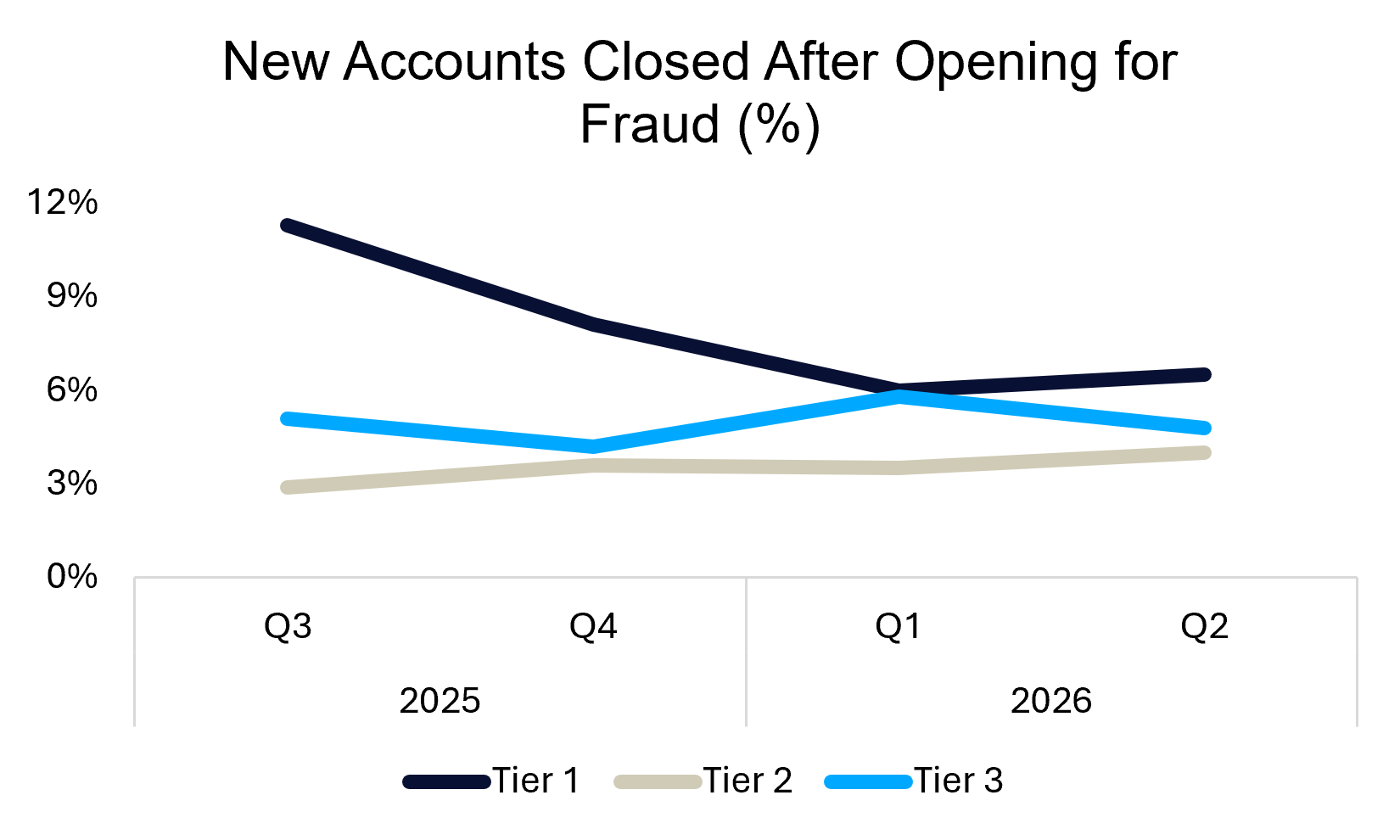
Fraud trends are diverging across the three asset tiers in Auriemma Roundtables’ Fraud Benchmark. At the largest institutions, the share of new digital accounts later closed for fraud has fallen, suggesting these institutions are catching more fraudulent applications during onboarding.
In the smallest tier, both the new-account fraud rate and net fraud losses per demand deposit account rose in the first half of 2026. Smaller institutions facing rising losses can use these trends to see how their experience compares with peers. Auriemma’s smallest tier combines results for banks and credit unions with less than $75 billion in assets, including every credit union in the benchmark. Bank size categories vary by agency and purpose. For banks, this tier spans the Federal Reserve’s community bank range (under $10 billion) and part of its regional bank range ($10 billion to $100 billion).
| Auriemma Benchmark Tier | Total Assets |
|---|---|
| Tier 1 | More than $1 trillion |
| Tier 2 | $75 billion to $1 trillion |
| Tier 3 | Less than $75 billion |
“Fraudsters are looking for places where they can open accounts and move money with the least resistance,” says Auriemma Roundtables Senior Director Troy Huth, who oversees Auriemma Roundtables’ Fraud Benchmark. “It appears that relatively smaller banks and credit unions could face more fraudulent activity with fewer resources to respond.”
The Effect of Strong Controls at the Largest Institutions
At the largest deposit institutions in Auriemma’s benchmark, the share of new digital accounts later closed for fraud fell 42% from Q3 2025 to Q2 2026. Huth has observed these institutions declining a greater share of new-account applications. Stronger screening may help explain the drop in closures. When an institution catches a fraudulent application during onboarding, the account never opens.
This analysis groups deposit institutions (including banks and credit unions) into three tiers based on total assets. Tier 1 institutions have more than $1,000 billion in assets; Tier 2 have $75 billion to $1,000 billion; and Tier 3 have less than $75 billion. The credit unions in this benchmarking cohort fall within Tier 3, alongside smaller banks.
One potential reason for the trend: Larger institutions have been increasing their decline rates for new accounts and placing more holds on deposits, according to Huth’s observations. These stronger onboarding controls can identify and reject fraudulent applications before accounts are opened, leaving fewer fraudulent accounts to detect and close afterward. Viewed alongside rising application decline rates, the reduction in post-opening fraud closures suggests that larger institutions are catching more fraud earlier in the process.
“Those changes make it harder to establish an account for fraud and gain access to deposited funds,” Huth says. “That is encouraging for the institutions strengthening those controls, but it also raises a question for everyone else: Where will the fraudsters try next?”
New-Account Fraud Hits Smaller FIs Differently
During the first half of 2026, the new-account fraud rate declined by 9% at Tier 1 institutions. Tier 2’s rate also remained below its late-2025 level, following a sharp decline in Q1.
In Tier 3, the rate rose in both Q1 and Q2 of 2026, climbing 24.5% over the first half of 2026 and surpassing the Tier 2 rate. By Q2, the smallest institutions had a new-account fraud rate closer to that of the largest institutions in Tier 1 than to that of midsize institutions in Tier 2.
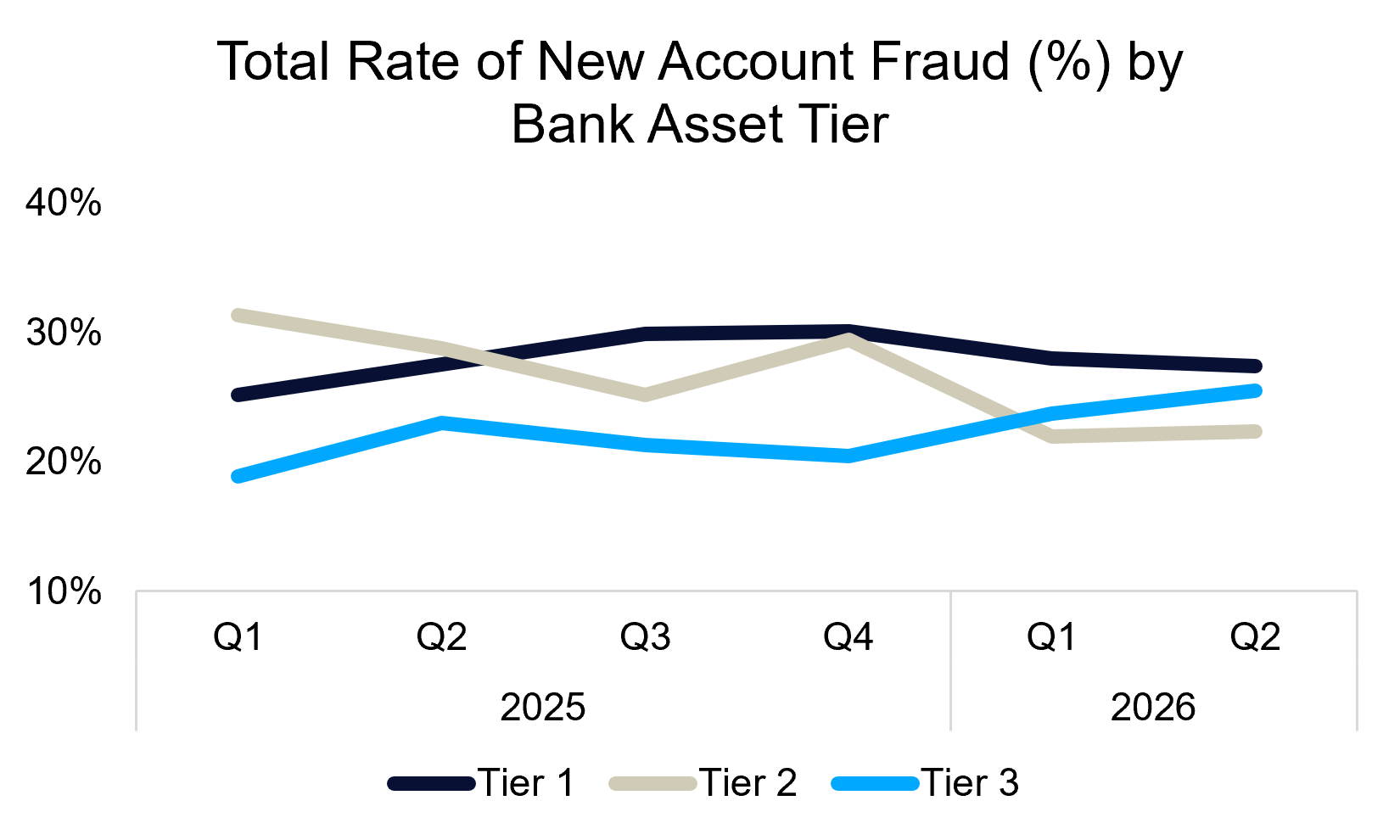
“A smaller institution can become an attractive target if criminals believe it offers an easier path to opening an account and moving money,” Huth says. “Fraud leaders need to consider whether their controls are ready for a change in the activity coming their way.”
The Financial Stakes Are Increasing
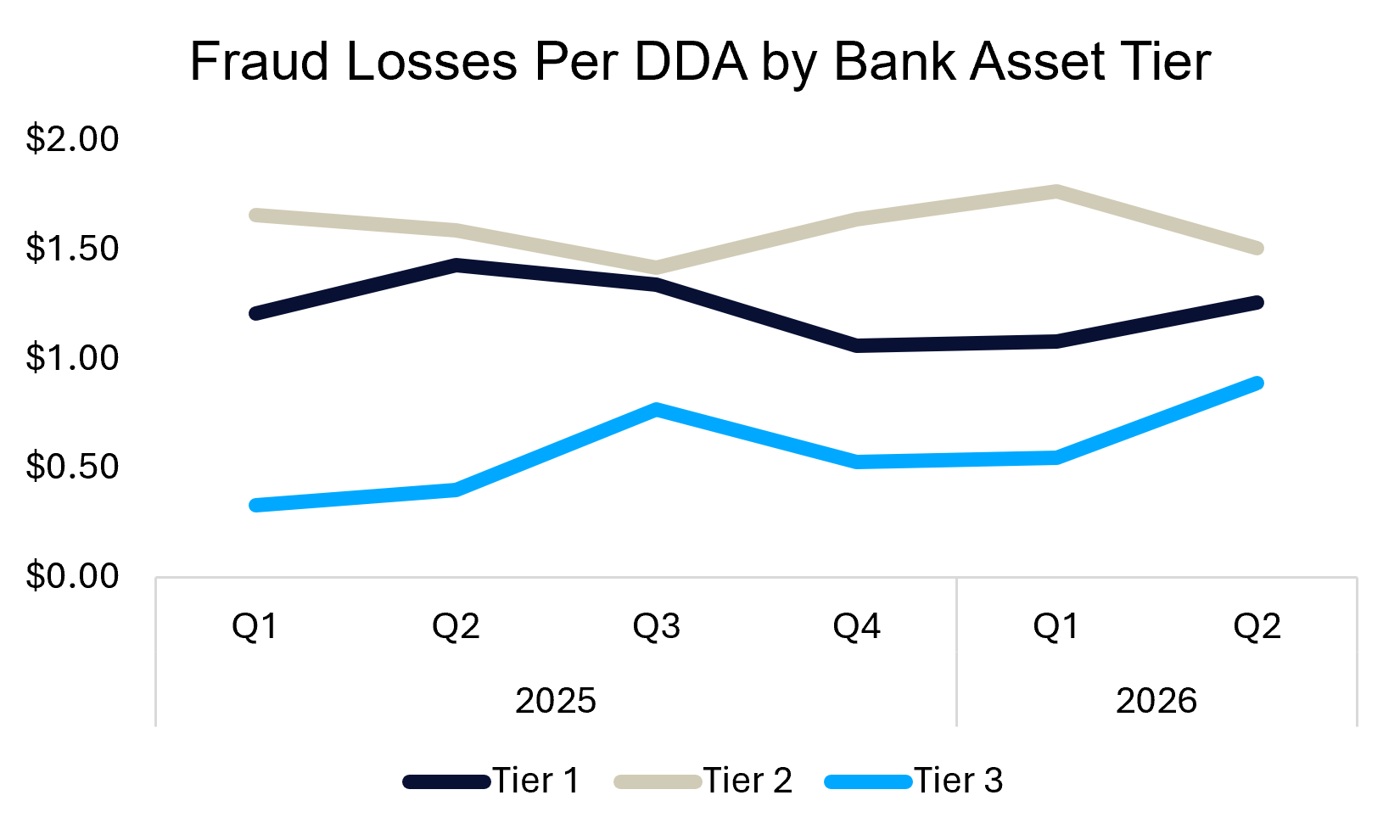
The increase in Tier 3’s new-account fraud rate coincided with rising net fraud losses per demand deposit account (DDA). Tier 3’s net losses increased sharply in Q2 2026, reaching their highest level in the six-quarter period and more than twice their Q1 2025 level.
Rising fraud losses can strain smaller institutions even when losses per account remain below those of larger peers. These institutions often have less financial capacity to absorb losses and fewer specialists to respond. A single team may be investigating cases, pursuing recoveries and strengthening controls while managing new attacks.
The data suggests significant, distinct challenges faced by smaller deposit institutions, including credit unions, Huth says.
“If this pressure continues and smaller FIs attract more attention from highly sophisticated fraud rings, a lean fraud operation could face a level of attack volume and complexity it has not dealt with before,” he says. “Waiting for losses to become a significant financial problem could leave the institution trying to catch up at the worst possible time.”
Putting Your Institution’s Experience in Context
The performance differences across FIs by size illustrate how important benchmarking performance is when building your fraud defense. To help in this effort, Auriemma Roundtables is offering complimentary benchmark preview a to qualifying community banks and credit unions.
Qualifying FIs may submit five fraud metrics and receive a customized benchmark report covering overall gross fraud losses per DDA, accounts declined for fraud, and gross losses per DDA across check deposits, ACH and wires.
Auriemma’s team begins with a brief call covering metric definitions, data anonymization and secure submission options. Benchmarking experts then review, validate and normalize the submitted data. Once the report is ready, the team walks through the findings with your institution to put the results in context.
To get your complimentary Fraud Benchmark Preview, complete the interest form or contact Jared Kirby at jkirby@roundtables.us.