12 E 49th St., 11th Floor, New York, NY 10017
T: +1-212.323.7000
E: info@roundtables.us

August 14, 2026
Fraud Is Top Concern in Payment Operations. APIs Can Help
To stay ahead of fraud, payment operations teams need to bring together risk signals that often sit across separate platforms, tools and customer histories. The ability to connect those signals before a transaction is completed is becoming central to payment operations.
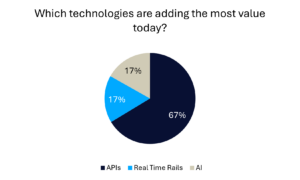
Recent survey data from Auriemma Roundtables’ Money Movement & Payment Operations Roundtable shows APIs lead the technologies delivering value today, beating out AI and real-time payment rails.
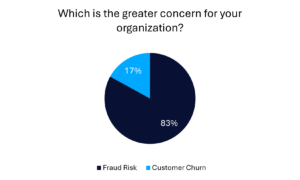
At the same time, an overwhelming majority of respondents identified fraud risk as their organization’s greater concern.
While respondents were not asked whether fraud capabilities drove their technology selections, the findings intersect in practice. As explored in Auriemma Roundtables’ recent whitepaper, The Quiet Reinvention of Payment Operations, APIs can connect payment and fraud systems, support real-time screening and help institutions apply consistent controls at the point of payment.
“Payment operations leaders are under pressure to move money faster while keeping fraud controls strong,” said Howard Fish, Director of the Money Movement & Payment Operations Roundtable. “The right technology enables institutions to evaluate risk in real time, intervene when necessary and allow legitimate transactions to move with minimal friction.”
APIs Lead Payment Technology Value
When payment operations leaders were asked which technologies are adding the most value today, 67% of respondents selected APIs. Real-time payment rails and artificial intelligence each garnered 17% of the votes.
The emphasis on APIs reflects the practical challenges facing payment operations teams. Many institutions must manage multiple payment rails, processors, gateways and fraud tools, often through separate integrations. Each connection can add development work, maintenance requirements and transaction costs.
APIs can help institutions connect those systems more efficiently and introduce new capabilities without rebuilding the underlying payment infrastructure each time. Depending on the institution’s architecture, APIs may also provide greater flexibility to route transactions based on cost, speed, availability or risk.
API design can also affect how much control an institution retains over its payment strategy. Important considerations include:
- Integration and ongoing maintenance costs
- Transaction routing flexibility
- Token portability between providers
- Encryption and data security
- Support for multiple payment rails
- Speed of implementation
- Dependence on individual vendors
These considerations help explain why APIs are creating more immediate value than technologies attracting greater public attention. AI and real-time rails offer significant potential, but APIs provide the connective tissue needed to integrate tools, move data and support consistent decisioning across the payment environment.
Fraud Is the Dominant Payment Operations Threat
While technology is creating opportunities, payment operations leaders must also weigh fraud prevention against customer experience. Overly restrictive controls can frustrate customers, push a payment method to the bottom of their wallet or drive them to another provider. Even with those risks, 83% of survey respondents identified fraud as the greater concern, compared with 17% who selected customer churn.
Meanwhile, threats are emerging across cards, digital banking platforms, P2P, ACH, and other money movement channels.
Institutions report fraud activity involving:
- Replacement card and credential update abuse
- Compromised POS devices
- Account takeovers
- Spoofed bank websites and search results
- Gift card schemes targeting provisional credits
Some financial institutions are responding with controls such as blanket card wipes, which prevent replacement card numbers from automatically updating with merchants. Others are enhancing fraud strategies, expanding internal monitoring and evaluating card issuance platforms.
Customer education, warnings and transaction notifications are also receiving more attention as scams become more sophisticated.
Authorized Scams Narrow the Window for Intervention
Many emerging fraud schemes are difficult to identify because the customer initiates and authorizes the payment. A victim responding to a bank impersonator, romance scam or other social engineering scheme may log in from a recognized device and complete authentication successfully.
Warning signs include:
- A first-time or unusual payee
- A sudden change in payment frequency or value
- Multiple transfers made with unusual urgency
- Inbound funds followed by rapid outbound movement
- Activity that differs significantly from the customer’s history
When customers recognize a scam quickly, their financial institution may be able to stop the transaction before it reaches the payment network. Recovery options become much more limited after an authorized payment has been completed, particularly when funds move over a real-time rail.
Technology Value and Fraud Control Are Converging
The two survey findings are closely connected. APIs deliver value partly because they can help institutions coordinate payment routing, fraud screening and transaction decisioning more efficiently.
The strongest payment technology strategies will account for both opportunity and risk. A faster connection has limited value if the institution cannot apply appropriate controls. A highly restrictive fraud strategy can also create unnecessary friction, increase costs and undermine customer experience.
Payment operations leaders are increasingly responsible for finding the balance. Their decisions shape how quickly money moves, what each transaction costs and whether the institution can intervene when activity appears suspicious.
As payment environments become faster and more interconnected, the institutions that pull ahead will be those that prioritize flexible infrastructure, disciplined cost management and transaction-level fraud controls.
Auriemma Roundtables’ Payment Operations Expertise
Auriemma Roundtables gathers payment operations insights through recurring member surveys, confidential roundtable discussions and collaborative benchmarking studies. These findings provide a view into how financial institutions are modernizing payment workflows, managing operational risk and responding to changes in payment technology and fraud.
The Money Movement & Payment Operations Roundtable brings together senior money movement leaders to compare performance, benchmark practices and discuss emerging challenges in a confidential, vendor-free setting. Contact Auriemma Roundtables to learn more about membership.
To learn more about membership, contact Warren Murphy.