
12 E 49th St., 11th Floor, New York, NY 10017
T: +1-212.323.7000
E: info@roundtables.us

October 6, 2026
How AI Will Change the Way Financial Institutions Operate
Takeaways from Auriemma Roundtables’ AI Lab, including industry transformation, data architecture, and the importance of human judgment.
Leaders from more than twenty companies representing a cross section of the financial services industry gathered to explore the practical challenges of AI implementation at Auriemma Roundtables’ inaugural AI Lab. Held September 22 & 23 at Eversheds Sutherland’s offices in Washington, D.C., the event brought participants together to share deployment lessons and examine how governance, vendor oversight and human review can keep pace with rapidly advancing AI capabilities.
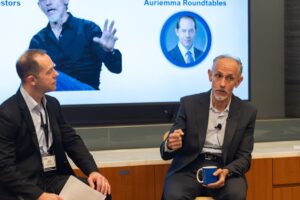
During a fireside chat, Nigel Morris, Co-Founder and Managing Partner of QED Investors and Co-Founder of Capital One, challenged leaders to reconsider the assumptions behind their businesses, from how they organize work to how they measure the value of customer interactions.
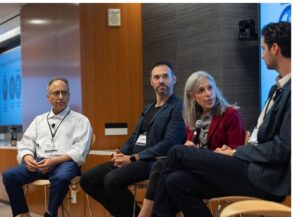
Leslie Bender of Eversheds Sutherland also moderated a panel discussion with Tyler Gillies of January, Joshua March of Veritus, and Krishna Gopinathan of Blue Sherpa. Their discussion examined the work behind successful implementation, including preparing data, defining AI’s responsibilities, and maintaining human oversight.
Together, the discussions connected the possibilities of redesigning a business around AI with the practical decisions required to make it work.
Redesign the Business Around the Outcome
Invoking John Locke’s concept of tabula rasa, or a blank slate, Morris encouraged leaders in attendance to imagine building their institution with AI available from the outset.
Starting from that blank slate puts the desired business outcome ahead of the current process. Leaders can reconsider which decisions should be made together, what information they require and where human judgment adds value. AI’s role then follows from that design.
For example, an institution redesigning an AI-connected marketing and credit engine from scratch could connect targeting, pricing and credit decisions around a shared understanding of customer value. That would change how the functions work together and how their performance is measured.
The collections function presents a similar opportunity. Starting from scratch would mean defining the desired recovery outcome, along with cost, risk and customer treatment requirements, before deciding how accounts should be managed. Leaders could then reconsider which customers need outreach, how and when to engage them, and where human intervention is most valuable.
That approach gives institutions room to challenge a process even when it appears efficient. A low-cost contact strategy may warrant redesign if it produces weak engagement and higher losses. A more expensive interaction may justify its cost through better recoveries. Evaluating those choices against the full financial outcome helps leaders determine what the collections process should look like—and where AI belongs within it.
Making Data and Unwritten Workflows Usable
Data architecture is a key constraint on AI adoption, particularly for institutions still integrating systems from prior acquisitions, according to Morris.
“Until you get your data architecture right, it’s very hard to really leverage AI,” he said.
Experienced employees often rely on tribal knowledge that never appears in a standard operating procedure (SOP), Joshua Gillies of January said, adding that teams should continually monitor AI logs and performance to ensure they adhere to unwritten protocols and historical context that may have been overlooked.
AI agents do not have access to undocumented tribal knowledge, and they need explicit instructions to operate within nuanced environments. Preparing a workflow for AI means documenting the responsibilities and exceptions that employees currently navigate through experience. Clean data alone cannot supply rules that were never written down.
In that light, Krishna Gopinathan, of Blue Sherpa, discussed “data archaeology,” defined as examining historical case data to align with current definitions. Comparing responses with both historical results and desired outcomes can reveal missing information or unclear instructions before implementation. That review helps teams determine whether the system can handle the circumstances it encounters in practice.
Experiment Often and Share What Works
Morris encouraged institutions to learn through internal experimentation and work with multiple vendors. Testing available tools helps teams understand which applications deliver value, what data they need, and implementation requirements.
Morris’s discussion of vendor selection reinforced that accountability. Institutions need enough understanding of a solution to evaluate its behavior and oversee its use, even when another company supplies the technology. He also recommended weighing internal builds against available vendor solutions before committing technology resources that may be better spent on foundational work, such as improving data architecture.
Those experiments become more valuable when their lessons reach other teams. Documenting what was tested, how it performed and what needed to change gives the organization a stronger starting point for subsequent projects. Institutions should establish ways to share and retain that knowledge, so it continues to inform decisions as tools and vendors change.
Outreach cadence and engagement modeling offer practical opportunities for AI in collections. For institutions testing multiple vendors, those applications provide a concrete basis for comparison: how effectively does each solution engage customers, and what do those interactions achieve? Panel members agreed that leaders should ask:
- How will we define success and establish a performance baseline before implementation?
- How will the vendor track and report relevant KPIs, including open rates, replies and complaints?
- How will we determine whether stronger engagement translates into better collection outcomes?
The answers give institutions a consistent basis for deciding which solutions to test and comparing their results.

Preserving Human Judgment as AI Takes on More Work
Optimization is no substitute for human understanding, said Morris. AI may identify a pattern or improve a metric without giving users a sound explanation of why the result works or exceptions.
“I’m a firm believer that you start with a hypothesis and a viewpoint, and then you test the hypothesis,” Morris said.
That discipline matters in credit and fraud, where decisions have regulatory consequences. Leaders need to understand the data supporting an outcome, assess whether it makes business sense and recognize the limits of applying it to other circumstances.
In some workflows, Joshua March, of Veritus, described how employees may move from being “in the loop,” reviewing or approving individual AI decisions, to being “on the loop,” monitoring performance and intervening when needed.
That oversight includes reviewing exceptions and recognizing when the AI has missed account history or circumstances that should change its response. As Blue Sherpa’s Gopinathan emphasized, humans remain “on the hook” for the AI’s behavior and outcomes. In other words, employees remain responsible for identifying compliance gaps and ensuring they are addressed.
Continue the Conversation in 2027
The value of AI will depend on the decisions institutions make around it: what to optimize, how to evaluate results and when people need to intervene. Comparing experiences with peers can help leaders test those decisions and identify gaps before expanding implementation.
The AI Lab is just getting started. Visit the AI Lab website to learn more about the discussions, explore what we covered and express interest in joining us in 2027.