12 E 49th St., 11th Floor, New York, NY 10017
T: +1-212.323.7000
E: info@roundtables.us

July 24, 2026
What Bank Size Reveals About Fraud Losses
Fraud losses continue to affect banks unevenly based on asset size, with Tier 2 institutions (those with between $20 billion and $999 billion in assets) reporting higher losses per DDA compared to Tier 1 banks (those with more than $1 trillion in assets). As risks shift, banks are tightening deposit holds, strengthening external account verification, and reevaluating their response to authorized scams.
Fraud has become a persistent operating pressure across banking, but the burden is falling unevenly. The distinction comes through clearly in Auriemma Roundtables Fraud Benchmark and Roundtable member discussions. Tier 1 banks (those with more than $1 trillion in assets) contend with enormous aggregate exposure across broad product portfolios and payment channels, supported by significant investments in specialized fraud controls. Tier 2 (those with between $20 billion and $999 billion in assets) institutions also serve millions of customers and process millions of transactions, but may have fewer resources over which to spread the cost of fraud prevention and losses. Those smaller Tier 2 institutions are adjusting deposit holds and funds-availability models as loss patterns shift.
Understanding those differences gives fraud leaders a clearer basis for evaluating their own results.
Across four of the five most recent quarters, Tier 2 banks reported higher average gross fraud losses per DDA than Tier 1 institutions. In Q1 2026, losses at Tier 2 institutions were roughly 79 cents per DDA, respectively, compared with less than 25 cents in Q1 2026 at the Tier 1 banks. Over the observed period, there was approximately a 40% difference between Tier 1 and Tier 2 institutions in aggregate.
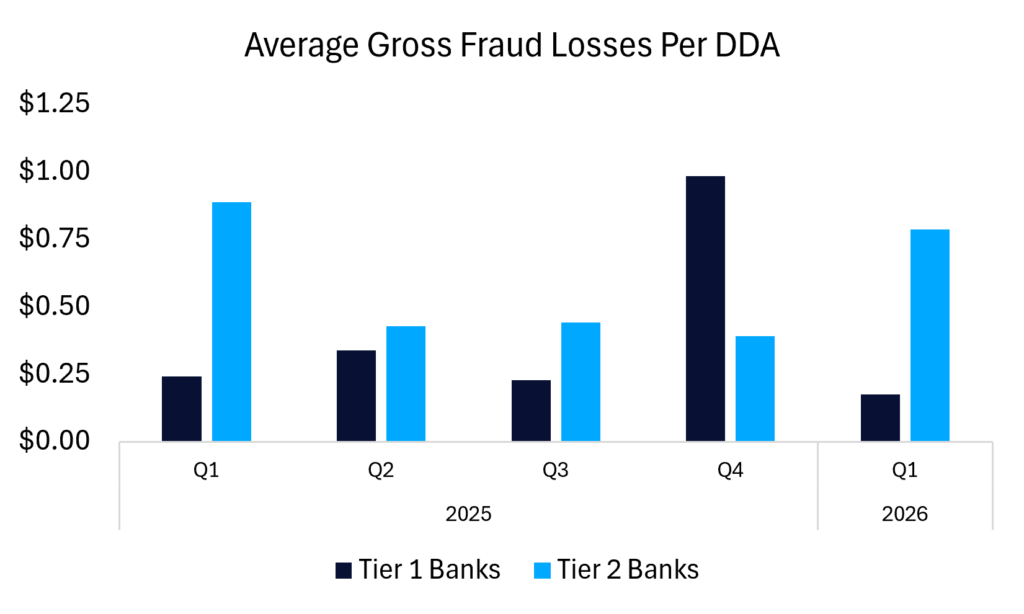
Several factors may be driving this gap, from differences in fraud controls and staffing to the types and volumes of transactions each institution processes.
Deposit Hold Strategies Vary Across Bank Segments
Automated deposit hold rates provide one of the clearest examples of how fraud responses differ by institution size.
Auriemma’s fraud benchmark data showed automated check hold rates were higher at Tier 1 institutions in all of the most recent five quarters.
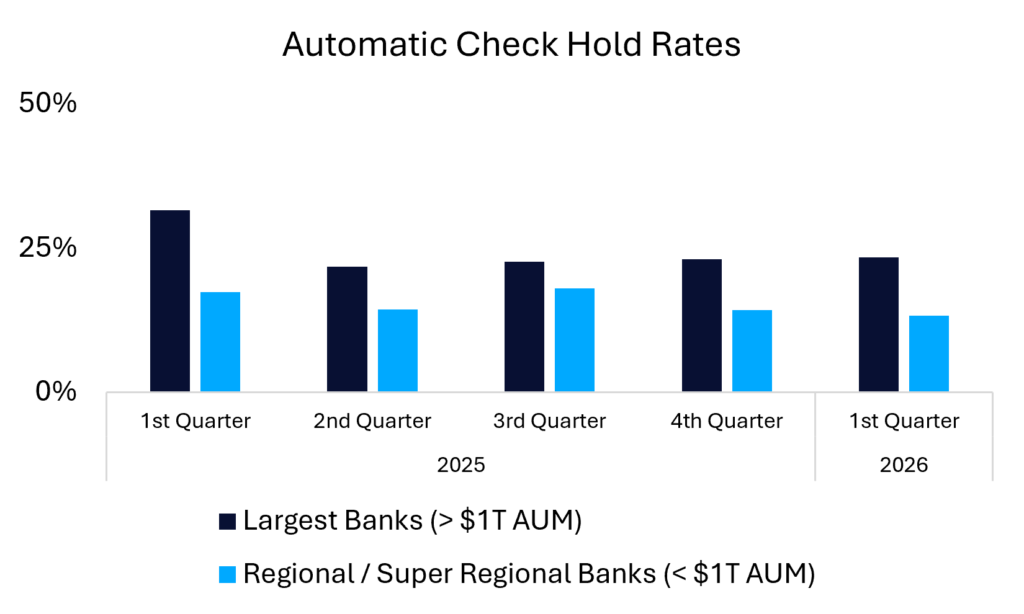
Troy Huth, Director of Auriemma Roundtables’ Bank Fraud Control Roundtable, has observed a clear shift among Tier 1 institutions. After historically placing automated holds on a relatively small share of check deposits, many have recalibrated their funds-availability models as fraud losses have grown, holding more deposited funds while deposits clear.
“At the largest banks, even a relatively small weakness in a hold model can create significant losses because of the sheer volume of deposits,” said Huth. “They also handle more deposits across mobile, branch, ATM, and commercial channels, so increasing automated holds can be one of the fastest ways to contain exposure while they refine their controls.”
Large institutions have historically maintained lower hold rates despite experiencing higher losses, but their technology allows them to place targeted holds in real time. Smaller banks often rely on batch-driven processes, leaving a window between deposit and hold placement. Gaps in automated coverage across channels create additional vulnerabilities and push fraudsters toward the least-protected deposit methods. As banks strengthen these controls, they must balance loss prevention with funds availability, regulatory requirements, operational capacity, and customer experience.
Tier 1 Banks Are Moving Faster on External Account Verification
Banks across the industry are strengthening external account verification as ACH fraud and unauthorized debit returns expose weaknesses in the trial-deposit process. Even a successful name match does not eliminate the risk. Fraudsters may use stolen identities to open accounts under matching names, link them, and move funds. Banks are also seeing first-party fraud in which accountholders transfer funds between their own accounts and then falsely claim the transaction was unauthorized, forcing a return. These schemes allow fraudsters and legitimate accountholders engaged in dispute abuse to pass standard verification controls while leaving the originating institution exposed.
Institutions, particularly the largest, are responding with account-owner authentication, third-party connectivity through services such as Plaid, and other real-time tools that confirm ownership more directly.
“We are seeing the largest institutions push further away from trial deposits and toward real-time account-owner verification,” said Huth. “Some have eliminated trial deposits altogether, while others now use them only when a stronger verification method is unavailable.”
Tier 2 banks are moving in the same direction, though adoption often depends on existing vendors, core-system capabilities, and implementation costs.
Improved detection rules and stronger verification processes have already contributed to lower debit-pull losses, though implementation varies widely by institution size. Large banks may have the resources and transaction volume to support broader deployment of advanced platforms, while smaller banks often work within the capabilities of their existing vendors and core technology environments. As these tools become more accessible, more institutions will be able to reduce the risk of fraudsters linking accounts they do not own.
Scam Losses Create Different Pressures
Regardless of institution size, authorized scams create a difficult challenge because customers initiate the transactions after being manipulated by fraudsters. The level of losses vary widely depending on the institution’s reimbursement policies, payment channels, customer base, warning practices, and ability to intervene before funds leave the account.
“In conversations with members, I’ve heard customer losses range from roughly 2x the bank’s losses to as much as 20 or 30 times higher,” said Huth. “Those ratios reveal who ultimately bears the financial harm. Bank losses alone can dramatically understate the scale of the problem.”
Fraud Responses Reflect Each Institution’s Operating Model
Institution size shapes the scale of exposure, the controls available, and the speed of response. The very largest banks may focus on stopping vulnerabilities before they spread across a mammoth sea of transactions. Tier 2 banks may prioritize stronger account verification while managing technology costs, staffing constraints, and customer friction.
Putting Your Own Fraud Results in Context
Fraud trends can look very different depending on an institution’s size, transaction mix, and operating model. Auriemma Roundtables’ fraud benchmarks help leaders move beyond broad industry averages by showing how losses, controls, and response strategies compare across relevant peer groups that account for institution size.
That context helps fraud leaders identify emerging exposure, evaluate control changes, and understand where their institution stands against relevant peers.
To learn more about Auriemma Roundtables’ fraud benchmarking and how your institution can use peer data to identify emerging risks, contact Jared Kirby.